


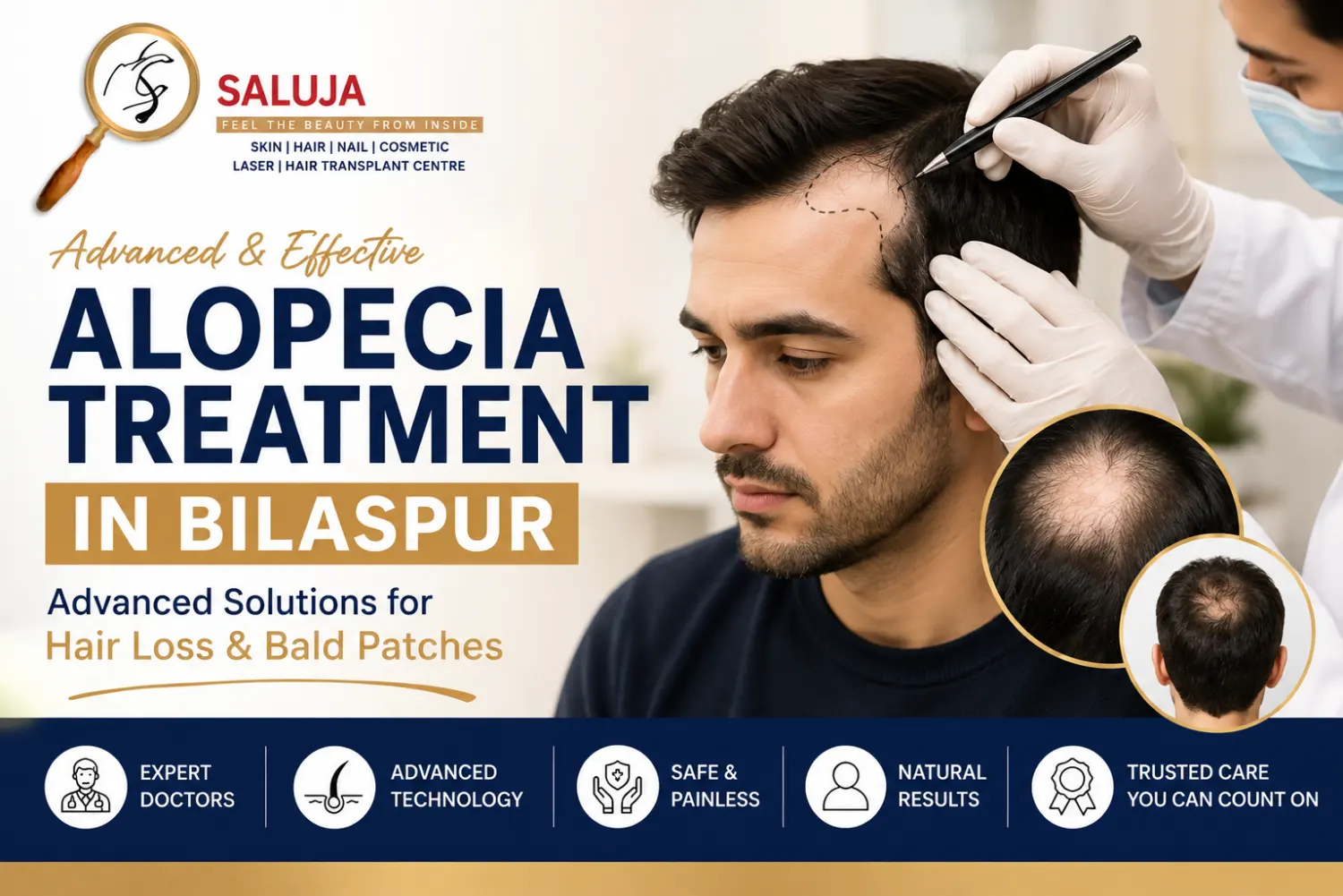
Alopecia is the medical word for hair loss. It happens when hair falls out faster than the scalp can replace it, or when the roots stop making new hair altogether. The common kinds are pattern baldness, patchy alopecia areata and sudden heavy shedding after an illness. Most kinds respond well to early, doctor-led alopecia treatment in Bilaspur.
The first sign is rarely dramatic. A few extra strands on the pillow. A parting that looks a little wider than last month. A wedding photograph where the light catches your crown and you look twice.
Hair loss arrives quietly, and by the time most people take it seriously they have already lost ground. That delay matters, because with hair, timing changes the outcome. Roots that are only thinning can usually be saved. Roots that have closed cannot.
So the real question is not whether you are shedding. Everybody sheds. The question is whether what you lose is coming back.
This guide answers that in plain words. What alopecia actually is. Who tends to get it. What each pattern looks like on the scalp. What sits behind it, from family history to iron levels to the way hair is tied every morning. And which remedies hold up in published research rather than in salon talk. If you have been putting off a proper check, this is the point where alopecia treatment in Bilaspur starts to make sense.
What is alopecia, in simple words?
Alopecia means hair loss of any kind. It is a description, not a single disease. Doctors use it for a receding hairline, a coin-sized bald patch, thinning at the parting and complete baldness alike.
Every hair works in a cycle. It grows for a few years, rests, falls out, and a new hair pushes up from the same root. An adult scalp carries roughly one lakh hairs, all at different points in that cycle. Alopecia begins when the cycle breaks: too many hairs rest at once, or the root shrinks until it makes only a thin colourless strand, or the root dies and nothing grows again.
Is losing hair every day normal?
Yes. Fifty to a hundred strands a day is ordinary. An Indian study set its cut-off at more than 100 strands lost per day, continuously, and used that as the line for hair loss worth investigating. One heavy hair-wash day proves nothing. Six weeks of heavy days means something.
Who gets alopecia?
Anyone. Alopecia has no respect for age or gender.
- Men usually notice it first at the temples and the crown, often from the mid-twenties onward.
- Women notice a widening parting and a thinner plait, while the front hairline stays put.
- Children and teenagers can get sudden round bald patches, which is alopecia areata.
- New mothers shed heavily two to three months after delivery, and this settles on its own.
- Anyone recovering from high fever, dengue, surgery, thyroid trouble or a crash diet.
- Anyone who ties hair tightly every day, which slowly pulls the edges bare.
How common is hair loss, really?
Far more common than people admit at the tea stall. A population study of 1,005 Indian men aged 30 to 50 found pattern hair loss in well over half of them, and it is the single largest reason people walk into a skin clinic for their hair.
| Type of hair loss | Group studied | What the research reports | Source |
| Male pattern hair loss | Indian men, ages 30 to 50 | 58% had some grade of pattern hair loss | Int. Journal of Trichology, 2009 |
| Male pattern hair loss (early grades) | Same Indian group | 44.1% at grades I to III, where medicines are the usual option | Int. Journal of Trichology, 2009 |
| Male pattern hair loss (advanced) | Same Indian group | 12.9% at grades IV to VI, where a transplant is considered | Int. Journal of Trichology, 2009 |
| Pattern hair loss (worldwide) | Men by age | About 50 to 60% by age 50, and about 80% by age 70 | Frontiers in Medicine, 2025 |
| Alopecia areata (patchy) | General population | Lifetime chance of about 2%, roughly 1 person in 50 | Clinical, Cosmetic & Inv. Dermatology, 2015 |
| Alopecia areata (active cases) | General population | About 0.1 to 0.2% have it at any given moment | StatPearls, NCBI Bookshelf, 2024 |
| Nail changes with alopecia areata | Patients with alopecia areata | 10 to 15% also get pitted or ridged nails | StatPearls, NCBI Bookshelf, 2024 |
What are the symptoms of hair loss you should not ignore?
Hair loss gives warnings long before a bald patch appears. Watch for these:
- Heavy shedding that keeps going for six weeks or more.
- Your parting looks wider in the mirror than it did six months ago.
- Scalp shows through under a ceiling light or in photographs.
- The hairline at the temples is stepping backwards.
- A smooth, round bald patch that appeared within days.
- Itching, burning or a shiny patch where you cannot see any pores.
- Short broken hairs along the edges, where the hair is pulled tight.
- Your plait or ponytail feels thinner in your hand.
- Small dents or ridges appearing on your fingernails.
Know more: Your Complete Guide to Hair Fall, Regrowth and Hair Transplants
When should you book for alopecia treatment in Bilaspur?
Book early rather than late. A sudden bald patch, shedding past three months, a scalp starting to show, or burning and shiny skin all deserve a proper look. Alopecia treatment in Bilaspur works best while roots are still alive, which is the very stage at which most people talk themselves out of seeing a doctor.
What are the types of alopecia and how do you tell them apart?
Doctors sort hair loss into two families. Non-scarring alopecia leaves the root intact, so regrowth is possible. Scarring alopecia replaces the root with scar tissue, and that loss is permanent. Knowing which one you have decides everything else.
| Type | What you notice | Usual pattern | Can hair grow back? |
| Male pattern hair loss | Temples move back, crown thins | Slow, over years | Not on its own. Medicines slow it, a transplant restores it |
| Female pattern hair loss | Parting widens, volume drops | Front hairline usually stays | Not on its own. Treatment can thicken and hold what is left |
| Alopecia areata | Smooth round patches, often overnight | Anywhere on scalp or beard | Often yes. It is self-limited in many people, though it can return |
| Telogen effluvium | Sudden heavy shedding, all over | Starts 2 to 3 months after a fever, delivery, surgery or crash diet | Yes, once the trigger is fixed |
| Traction alopecia | Thin edges, broken short hairs | Along the hairline and temples | Yes if caught early. Permanent if the pulling continues |
| Scarring alopecia | Shiny patch, no visible pores, may itch or burn | Spreads outward slowly | No. Early care protects the hair around it |
What causes hair loss?
Hair loss has many possible causes. The most common include:
- Family history and hormones. The commonest cause by far. Roots inherit a sensitivity that makes them shrink slightly with each cycle.
- Iron and diet gaps. Very common in Indian patients, and easily fixed once found on a blood report.
- A shock to the body. Dengue, typhoid, high fever, surgery, childbirth or sudden weight loss push a batch of hair into the resting phase at once.
- The immune system. In alopecia areata, the body mistakes its own roots for something foreign.
- Thyroid and PCOS. Both change the hair cycle and both show up on simple tests.
- Tight hairstyles. Daily tight plaits, buns and extensions pull the edge hairs out slowly.
- Scalp problems. Heavy dandruff, fungal infection and constant itching damage roots over time. See the best dermatologist in Bilaspur early if your scalp itches daily.
- Some medicines. A few drugs for blood pressure, arthritis, depression and cancer list hair loss on the label.
- Local conditions. Bilaspur heat, humidity and hard bore-water leave the scalp greasy and itchy, which worsens whatever else is happening.
What did Indian research find behind hair loss?
A cross-sectional study of 100 Indian adults aged 18 to 40 with hair loss (62 women, 38 men) measured their nutrition levels. The gaps it found were widespread, and they showed up across every type of hair loss, not just one.
| What was measured | Group | Share found deficient | Why it matters |
| Iron stores (ferritin, transferrin saturation) | Telogen effluvium and female pattern hair loss | Lower than in male pattern hair loss | Low iron is a leading and very fixable cause of shedding in women |
| Zinc | Male pattern hair loss | 11.76% | Zinc supports the growth phase of the hair root |
| Copper | Male pattern hair loss / telogen effluvium | 29.41% / 31.48% | A trace mineral tied to normal hair pigment and strength |
| Leucine (a protein building block) | Female pattern / telogen effluvium | 100% / 98.15% | Hair is nearly all protein, so protein gaps show up in hair first |
| Alanine | Female pattern / male pattern / telogen effluvium | 91.67% / 91.18% / 90.74% | Points to overall protein shortfall in ordinary Indian diets |
Source: Gowda, Premalatha and Imtiyaz, International Journal of Trichology, 2017.
What are the remedies that actually work?
The honest part first. No oil, shampoo or kitchen remedy will regrow hair from a root that has closed. What daily care can do is stop good hair leaving early, and that counts for a lot.
What helps at home?
- Protein at every meal: dal, egg, paneer, curd, fish or soya.
- Iron-rich food: green leafy vegetables, jaggery, dates and rajma, with lemon or amla to help absorption.
- Loose hairstyles. Give the roots a rest from tight plaits and buns.
- A mild shampoo two or three times a week, and proper dandruff treatment instead of scratching.
- Pat hair dry rather than rubbing it hard with a towel.
- Seven to eight hours of sleep, because the body repairs on its own schedule.
- A water filter or softener if your bore water is very hard.
What does hair-loss treatment in Bilaspur usually involve?
Once a doctor knows the type, the plan is straightforward. Proper hair-loss treatment in Bilaspur means prescription lotions and tablets, sessions that feed the roots, and surgery only where the roots are gone. The table below shows what published trials report for each option, so you know what to expect before you spend a rupee.
| Remedy | What it does | What the studies report | Source |
| Fixing diet and iron gaps | Refills what the root needs to build hair | Deficiencies found across all hair loss types in Indian patients | Int. Journal of Trichology, 2017 |
| Minoxidil lotion on the scalp | Keeps roots in the growing phase longer | Visible change usually takes 4 to 6 months of daily use | Skin Health and Disease, Oxford, 2025 |
| Minoxidil with finasteride (men only) | Slows shrinking of the root and feeds it | Ranked the strongest pairing for men: about 29.7 extra hairs per sq cm at 24 weeks | Frontiers in Medicine, 2025 |
| Oral minoxidil with finasteride, 12 months | Doctor-supervised tablets for men | 92.4% of 502 men were stable or improved at one year | Retrospective service evaluation, 2025 |
| PRP (your own blood platelets) | Injections that stimulate resting roots | Over 80% of trial participants improved at least 40% from baseline; 66% who had four or more sessions rated results good to excellent | Skin Health and Disease, Oxford, 2025 |
| Hair transplant (FUE or FUT) | Moves your own permanent roots to bare areas | Suited to advanced grades, which was 12.9% of Indian men aged 30 to 50 | Int. Journal of Trichology, 2009 |
One caution worth repeating. Minoxidil and finasteride are prescription medicines, not general tonics. Finasteride is for men only and must never be taken by women who are pregnant or may become pregnant. Buying either on somebody else’s advice is how a fixable problem turns into a stubborn one.
Where do you get the best alopecia treatment in Bilaspur?
Hair needs a doctor who examines the scalp properly, orders the right blood tests and can carry the case from lotion to surgery if it comes to that. At Saluja Skin Clinic, Mandir Chowk, Jarhabhata Road, that work is led by Dr. Jaspal Singh, a dermatologist, cosmetologist and hair transplant surgeon with over ten years of practice.
He trained in hair transplantation at Bengaluru under Dr. Venkatram Mysore, learning the FUT and FUE methods along with beard, body-hair and scar work, and later trained in lasers in Mumbai. His clinic was the first hair transplant centre in the whole of Bilaspur district. Skin, hair and nail care sit in one place, so patients are not sent from address to address for tests, injections and surgery.
What happens on your first visit for alopecia treatment in Bilaspur?
- A proper history: when shedding started, family pattern, illnesses, diet, medicines and hairstyle habits.
- A close look at the scalp under magnification, to see whether roots are thinning or gone.
- A gentle pull test to measure how much hair is loose right now.
- Blood tests where needed, usually iron, thyroid and vitamin levels.
- A written plan with realistic timelines, and a review date to check whether it is working.
How does Saluja Skin Clinic compare with other options nearby?
You have choices in Bilaspur and Raipur, and it helps to see them side by side. The table below lists what each clinic publishes about its own hair services.
| Clinic or hospital | City | Lead doctor | Hair services listed publicly |
| Saluja Skin Clinic | Bilaspur (Mandir Chowk, Jarhabhata) | Dr. Jaspal Singh | Skin, hair and nail care, lasers, PRP, hair transplant (FUT and FUE). First hair transplant centre in Bilaspur district |
| The Kosme Care | Bilaspur (Jarhabhata) | Dr. Alok Sultania | Skin, hair, laser and aesthetics, PRP, phototherapy |
| Dr. Sinha’s Skin & Hair Clinic | Bilaspur | Dr. Sinha’s team | Skin care, laser, hair transplant, cosmetic surgery |
| Dr. Ujjwala’s Skin Clinic | Raipur (New Rajendra Nagar) | Dr. Ujjwala Verma | Hair thinning and baldness care, PRP, mesotherapy, lasers, hair transplant. Also markets to Bilaspur patients |
| Apollo Hospitals / CIMS | Bilaspur | Hospital departments | Dermatology as one department inside a multi-speciality hospital |
| CARE Hospitals | Raipur | Hospital departments | Dermatology as one department inside a multi-speciality hospital |
What should you do next about your hair loss?
Hair loss is common, but it is not something you have to simply accept. Most of what walks into a skin clinic is treatable, and the rest can usually be held steady so nothing more is lost. What separates a good outcome from a poor one is almost always how early somebody asked for help.
So count your strands honestly. Look at your parting in daylight. If something has changed, get it checked rather than waiting for the next festival photograph to confirm it. Good alopecia treatment in Bilaspur starts with one honest examination, not with another bottle of oil.
To book a consultation at Saluja Skin Clinic, call +91-93016 00500 or +91-77524 14748, or visit Mandir Chowk, Main Road, Jarhabhata Road, Bilaspur 495001. The clinic runs Monday to Saturday, 10:00 am to 1:30 pm and 5:00 pm to 8:30 pm.
This blog is general health information. It does not replace a consultation. Please see a qualified dermatologist before starting any medicine or procedure.
Frequently asked questions about alopecia
Is alopecia the same as baldness?
Not quite. Alopecia covers every kind of hair loss, from a small patch to thinning at the parting. Baldness is one outcome of it. Most people with alopecia never go fully bald.
Can alopecia be cured completely?
It depends on the type. Telogen effluvium and early traction alopecia usually recover fully once the cause is fixed. Alopecia areata often regrows by itself but can come back. Pattern hair loss has no permanent cure, though it can be slowed for years and corrected with a transplant. Scarring alopecia cannot be reversed, which is why early care matters.
How much hair fall is too much?
Fifty to a hundred strands a day is normal. Losing more than a hundred a day, every day, for six weeks or longer is the point to get it examined.
Does hair loss run in families?
Pattern hair loss usually does. It can come from either parent, not only the father, which is why the old grandfather rule is unreliable. Alopecia areata sometimes runs in families too.
Does stress cause hair loss?
It can. A big physical shock such as fever, surgery, childbirth or sudden dieting pushes many hairs into the resting phase, and shedding shows up two to three months later. This kind usually settles once the body recovers.
Is PRP better than a hair transplant?
They do different jobs. PRP stimulates roots that are still alive and thinning. A transplant moves permanent roots into areas where nothing is left. Many patients need both at different stages, and a doctor decides based on your grade of hair loss.
How long does alopecia treatment in Bilaspur take to show results?
Give it four to six months. Hair grows about a centimetre a month, so nothing visible happens in the first few weeks. Stopping too early is the most common reason treatment appears to fail.
Where can women get hair-loss treatment in Bilaspur?
Saluja Skin Clinic treats female pattern hair loss, post-delivery shedding, thyroid-related hair fall and traction alopecia. Female patients are usually checked for iron, thyroid and vitamin levels first, since these are common and easy to correct.